Yon — worldbuilding notes
Edit history
- 2026-07-04: Elaborate on magic and its history
- 2026-07-14: Add link to 'Of elves and worlds' blog post
Table of contents
Much of my art from 2024 onwards has been situated in a fictional world I call Yon. This note documents what is known so far about this world, its inhabitants and events.
Overview and motivations§
The basic idea can be summed up as "solarpunk meets fantasy" — an optimistic view of a future world where our present-day ecological and social crises have been largely solved, populated by a collection of fantasy tropes. Technology and science play an important role (although some people, like the forest elves, forego most of it in favor of a simpler lifestyle), but the most striking difference to our world is in social organization: there are no states, borders, or governments, indeed no coercive hierarchies of any kind, and different groups choose different ways to exist among themselves.
While the ideas of social organization in Yon are based on real-world historical societies (The Dawn of Everything by Graeber & Wengrow being a particular source of inspiration) and various anarchist texts, realism in this regard is not a primary concern — this is absolutely a utopian project full of wishful thinking. It's also not a world of larger-than-life stories and high conflict, lending itself mostly to cozy slices of life and an aesthetic backdrop for whatever I feel like drawing at any given time.
It wasn't always this serene, though. The ancient history of Yon is full of war and struggle, and remnants of past evils remain to this day in corners of the world where few dare trespass.
This project has grown to be more personally meaningful to me than I ever expected. I've written down some of my thoughts and feelings about it in this blog post.
Geography§
Yon is a spherical planet resembling our Earth in climate and wildlife but not sharing its precise shape. I've yet to draw any maps or come up with names for locations, but most stories so far are situated in the northern woodlands, which coincidentally look a lot like the terrain around my own home in Finland.
Science and technology§
Without material scarcity and social inequality, science and art have become the predominant pursuits of much of Yon's population. The resulting advances in food and energy production, transportation, construction materials, urban planning, etc. etc. (I have not though through these in much detail yet) have been accompanied by a downsizing of cities to ensure each community can be entirely supported by locally procured food and water.
Magic§
There are rare creatures on Yon that hold inherent magical powers, nature spirits such as dryads being the most prominent example. For everyone else, magic requires raw materials which are generally very difficult to obtain: arcane carbon chains and aether-conducting manadium crystals from deep beneath the earth, microscopic motes of raw life-force diffused across the oceans, threads of pure thought woven by the now-presumed-extinct dream spiders of Soporia, the fire of a dryad's heart freely given. For most people across most of history, magic was the stuff of folk myths and tall tales.
Centuries ago, as industrial methods of extraction became available, a handful of factions began to gather huge stockpiles of these materials. They built the most destructive arsenal of weapons ever known, subjugating the peoples of Yon under mighty nation-states and culminating in the pivotal war now known as the Excess. Some decades later, as the last of the rulers who brought on this calamity were finally done clinging onto their power, it was decided that the remaining stockpiles of raw magic should be destroyed and none ever created again. Some were literally launched into the sun, others wiped from existence with their own destructive power, others still channeled back into the nature from whence they came to scab over the deep wounds left in the planet.
Magic still lingers in the places most affected by the Excess — the residue of weapons and monsters too dangerous or difficult to clean up, the places too far gone to keep living in. Many magical materials can still be obtained, but attempts to create new industrial-scale operations have been rare and swiftly rejected, with violence if necessary.
Today, magic continues to be widely shunned, even hated, much like the systems of power that allowed its consolidation to happen. There are always those driven to dabble with it out of curiosity or greed, perhaps even out of noble intentions, but those who refuse to stop at angsty teenage smoke spells and love potions tend to find themselves cast out of communities and left to fend for themselves. Some say it's a shame that such a powerful feature of the universe is left untouched and unresearched, but most would agree there's more than enough power and interesting things to learn in ordinary materials.
Characters§
Any fantasy archetype you can think of probably exists in this world. This section documents the ones known so far and their ways of life.
None of these societies are ethnically homogeneous, except insofar as their living arrangements demand unique physiology (as with the merfolk for instance) — people are free to move from place to place, so there are elves living among the dwarves, fauns among humans, and so on, culminating in cities where you can find representatives of just about any group.
On names: Childcare is generally seen as a communal affair in Yon, de-emphasizing the nuclear family and relations of blood. Consequently, family names are not in common use; people are typically referred to by their first name only. (This certainly has nothing to do with me being lazy about coming up with names.) In densely populated areas where name collisions are common, people pick their own secondary names or suffixes to differentiate themselves, often relating to the communities or heritage they consider important.
Forest elves§
The elves of the northern wilderness are nomadic hunter-gatherers who spend the summer seasons in small bands living in tents, hunting and fishing with bow and arrow. At the onset of winter they congregate at permanent settlements consisting mostly of underground dwellings dug into cliffs and hillsides. These settlements are typically placed near cities to facilitate trade and provide access to urban healthcare should it be needed.
The elves prefer their traditional analogue technology, but they do not entirely reject modern machinery and electronics. Most groups carry a few solar panels with them to power communication devices and small-scale refrigerators.
Elven fashion is rugged and practical, but also features a great deal of handcrafted decorative embroidery. Common visual motifs include the triangle, symbolizing the elves' lean and simple lifestyle, and various floral patterns.
Characters:
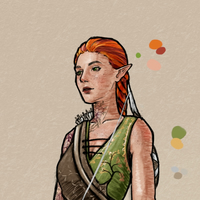
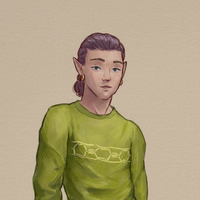
Dryads§
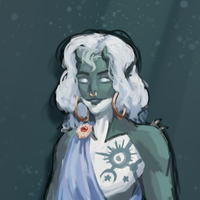
The dryads are magical embodiments of trees and caretakers of the forest. There are not many of them in the world, but those that are there are functionally immortal, their bodies being only a vessel which they can regrow into any shape at will. They typically choose feminine humanoid forms dressed with a blend of earthly gardening aesthetics and high-class fashion evocative of classic fantasy sorcerers.
The magic of growth is not only limited to the dryads' own bodies, but larger-scale creation requires a great deal of energy which they use with discretion. Much discretion is also exercised over the complementary power, that of destruction through fire. Most of the time, the dryads simply watch over the natural world, maintaining its balance and diversity through nigh-imperceptible nudges of magic. Although they mostly keep away from settlements, they've been known to help farmers during difficult years.
Characters:
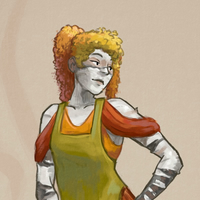
Fauns§
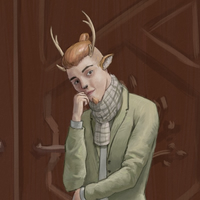
Fauns are curious and often mischievous creatures. After they first ventured from their tiny forest dwellings into cities, many of them have found a natural home for themselves at university campuses, where they're stereotypically known as good students and scientists with a propensity for jokes and pranks.
Characters:
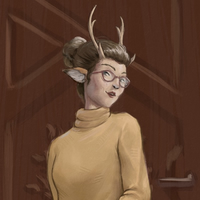
Mountain dwarves§
The dwarves in their underground halls have always been known as pioneers of technology, beginning as expert miners and steelworkers and eventually progressing into electronics and energy infrastructure. Mountains inhabited by dwarf-folk can be recognized from great distances due to the wind farms and solar panels strewn across their sides to power their factories, and many people come to them for trade and mentorship.
No individual characters designed yet.
Merfolk§
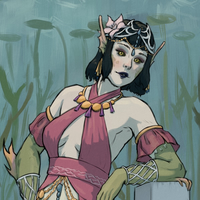
In ancient days the merfolk, known then as sirens, made their sustenance by luring sailors to their deaths. They always found this rather cumbersome, and over many generations managed to adapt to eating fish, which was much easier to hunt, and vegetables, which they could grow themselves. In the modern day they are friendly creatures, collaborating with ground-folk in farming, art, and science, some opting to join terrestrial universities or ateliers where they move using specially designed wheelchairs.
The song and visual beauty which were once used to lure sailors still run deep in merfolk culture. They dress themselves in elaborate clothing and jewelry, build grand halls decorated with paintings and sculptures, and give musical performances which are prized and sought after all over the world.
Characters:
City life§
There's no central government and thus no two cities operate exactly the same, but there are some general features found almost everywhere. Most resources are distributed via a system that resembles our libraries, where they are gathered into common locations and borrowed or taken as needed: tools at tool libraries and shared workspaces, food at community pantries, fridges, and kitchens, and so on. Computer-based distributed planning systems are often used to organize production and distribution.
Nobody is required to do anything to be allowed to take what they need, but there's a cultural expectation to participate. "From each according to ability, to each according to need", if you will. Most people find themselves cooking in community kitchens and working in gardens on a few days of the week, while some do their part by dedicating themselves to more complex crafts like plumbing, construction, or teaching. Almost everyone does multiple kinds of communal work, each for a few hours to a day per week, but the majority of time is spent on personal pursuits, whether they be science, art, sports, or just having a good time.
That's all for now. More to come later!