Finding my artistic voice
"Finding one's voice" is a phrase that doesn't admit a rigorous definition but feels like an accurate description of my current moment with visual art. I've been thinking about why I relate so strongly with these words right now, and wanted to dump some of those thoughts into a brief blog post.
This might come across a little self-congratulatory, which it is, but perhaps there's some interesting insight hidden in here too.
This is not something obvious that will stand out if you look at my recent art, especially if you only follow what I've put on this website. It's certainly not about style — while I've continued to experiment with different styles, I've not made any major changes to my default ways of doing things. (In fact, I consider "finding your style" a beginner trap that can seriously hinder artistic growth. But that's neither here nor there.) There has been a significant qualitative shift, but it's not in the outcomes but in the process and how it feels to make art. It's about skill, confidence, and intuition.
I've been drawing for almost exactly 11 years now (if you start the timer at my oldest piece of digital art — one year ago I made this post commemorating a decade of progress). There have been many big leaps in skill along the way, but usually those have focused on one fundamental or another: "Wow, my lineart is getting good!" "I kind of get value and form now!" "The way I painted this light feels right!" and so on. There was never this holistic sense of a "voice" emerging, whatever that means. What seems different now is how all these little bits of progress are supporting and amplifying one another, converging into something bigger.
This sense of convergence has been building over weeks and months, but the following sketch was when I felt it strongly enough to notice something special going on:
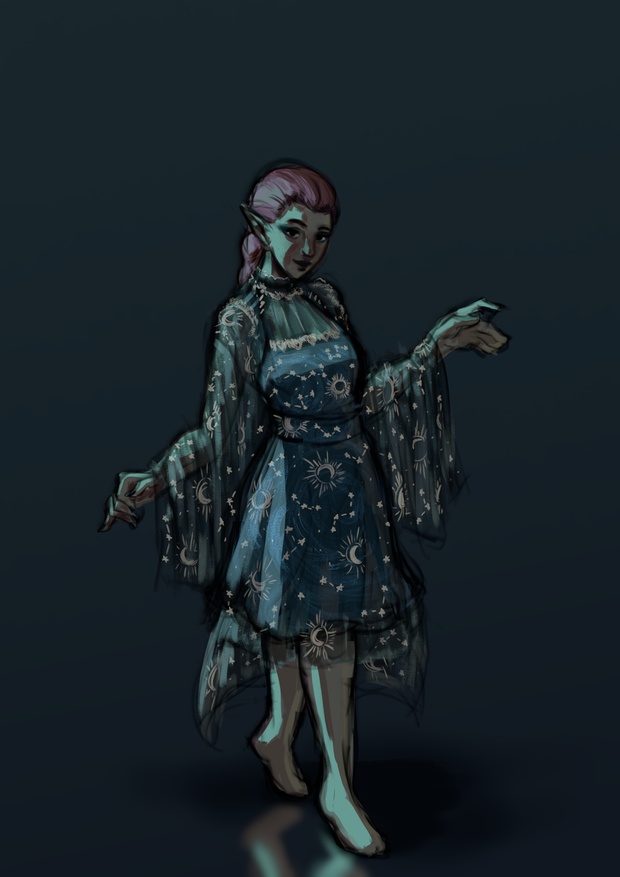
This is a real dress that I saw as a "draw your OC in this" challenge on Mastodon. According to Google reverse image search it seems to be this one.
So what's the big deal? I did this in a couple of hours entirely from imagination, and there were so many things that just felt right.
Perspective and gesture: I can place things in three-dimensional space with flow and movement. I've built a strong enough intuition for perspective to feel unconstrained in my choice of camera angles (this one has a slight downward tilt that's deceptively challenging).
Anatomy and acting: I understand the human body well enough to pose a character in a way that conveys mood and personality.
Color and light: I can come up with believable dramatic lighting and be playful with my color choices without relying on copying references or limiting myself to replicating reality. Color has gone from a dauntingly vast abyss to an exciting space to toy with.
There are more examples I could show and more fundamentals I could list, but let me jump to the point I'm trying to make:
What all these things have in common is a newfound sense of freedom to play, explore, have fun. I think this is that qualitative shift, that sense of "finding my voice" that I'm experiencing: art as a whole, thanks to all these individual skills reaching similar thresholds, is becoming less of a technical challenge and more of an expressive one, a space for play and joy. The "voice" is the ability and confidence to put ideas to paper, opening up the entire space of concepts (or at least a significantly larger region of it than before) for discovery.
Much of this is precipitated by the simple fact that I've been practicing more than ever lately — over 200 pages of art in 2025 alone. And in hindsight, I think it's important that a lot of this practice was done with traditional methods. Painting in gouache and drawing in ink, while initially intimidating on account of lacking an undo button, has excised (most of) my fear of failure and allowed me to embrace mistakes and messy marks, leaving my art richer and more interesting. I'm no longer put off by the blank canvas, allowing me to get more practice done and thereby further accelerating my progress.
This is not to say that nothing's a struggle anymore, or that I'm remotely close to "mastery" of anything. There's still plenty to learn about the fundamentals, plenty of subject matter I don't understand at all, and plenty of artists whose work puts me in awe, wondering if I'll ever make it halfway to their level. Viewers of my art might not even notice a difference. But for me, it feels like the beginning of something.